 |
Morse Micro IoT SDK
2.13.1
|
|
Morse Micro IoT SDK
2.13.1
|
The Morse Micro IoT SDK provides a framework for developing embedded applications that include connectivity provided by Morse Micro transceivers.
This SDK provides out of the box examples for the Morse Micro IoT Reference Platforms. The two main components of these platforms are a Morse Micro Wi-Fi HaLow transceiver and an MCU Host for running application firmware. Note that you can use your own platform but some additional work will be required.
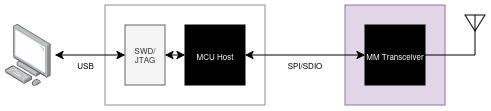
This SDK package contains the software components to build the application firmware for the STM32 processor. These components include:
libmorse_nocrypto.a or libmorse_nosupplicant.a or building morselib from source.A high-level block diagram of the SDK software components is shown below.
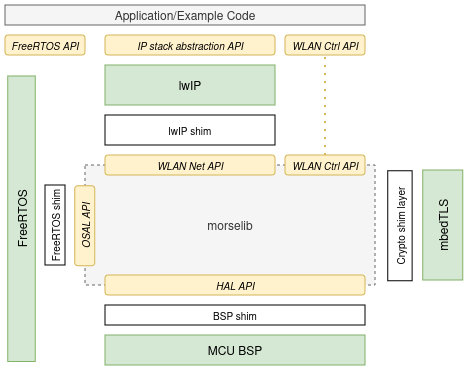
The Morse Micro host software included in morselib provides the driver interface for communicating with the transceiver and the upper layers of the Wireless LAN MAC, as well as additional application-layer network protocols. APIs provided by morselib include:
In addition to the APIs provided by morselib, supporting infrastructure includes:
The Getting Started Guide provides step-by-step instructions for getting up and running with this SDK using a Makefile-based workflow.
When a morselib feature is under development, and is not yet ready for production deployment, the associated APIs will be annotated to indicate the level of feature maturity.
Alpha — Suitable for initial evaluation only, not for production use. The API is incomplete, likely to change, and bugs are expected.
Beta — Suitable for evaluation and prototyping, but not recommended for production. The API is feature complete but may still change. Known issues are documented.
In general, unmarked APIs can be considered production ready with a stable interface.